
Top 10 Applications of White Masterbatch in Plastic Manufacturing: Benefits, Uses & Buyer’s Guide

White Masterbatch has become one of the most widely used color concentrates in the plastic manufacturing industry. From food packaging and household products to automotive components and agricultural films, manufacturers rely on high-quality White Masterbatch to achieve excellent brightness, opacity, and product consistency.
A premium White Masterbatch not only enhances the visual appeal of plastic products but also improves processing efficiency, UV resistance, and overall product performance. Choosing the right formulation ensures better color uniformity, reduced production waste, and long-lasting product quality.
As a trusted White Masterbatch Manufacturer in India, Rang Mahal (Sachcolor) offers high-performance White Masterbatch solutions designed for a wide range of plastic processing applications, helping manufacturers achieve consistent results across different industries.
top-10-applications-of-white-masterbatch
What is White Masterbatch?
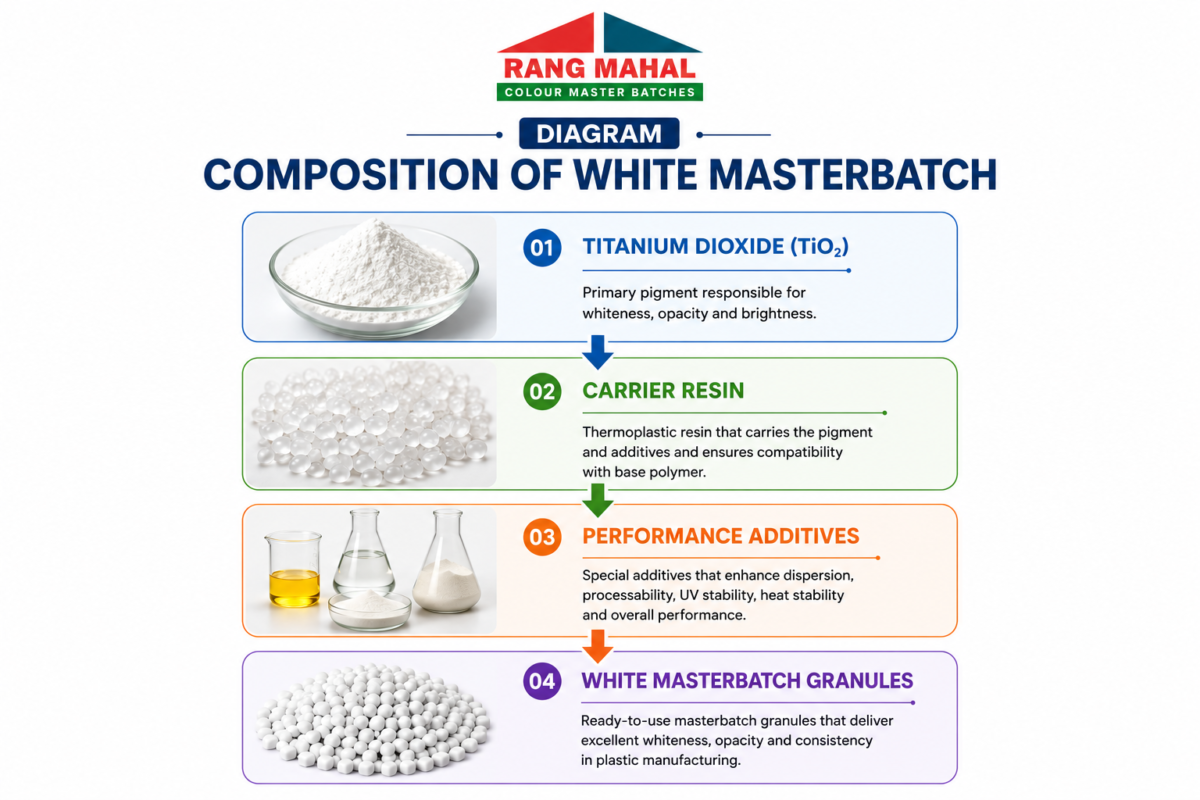
White Masterbatch is a highly concentrated blend of premium Titanium Dioxide (TiO₂), carrier resin, and performance-enhancing additives. It is specifically developed to impart bright white color, high opacity, excellent dispersion, and superior surface finish to plastic products.
Instead of mixing pigments directly during production, manufacturers use White Masterbatch because it provides consistent color distribution, minimizes dust, and improves production efficiency.
It is compatible with several plastic materials, including:
- Polypropylene (PP)
- Polyethylene (PE)
- HDPE
- LDPE
- LLDPE
- PVC
- ABS
- Polystyrene (PS)
This versatility makes White Masterbatch suitable for multiple plastic manufacturing processes, including injection moulding, blow moulding, extrusion, film production, and rotational moulding.
Composition of White Masterbatch Granules
Key Components of White Masterbatch
The quality of White Masterbatch largely depends on the raw materials used in its formulation. Each component plays a specific role in delivering consistent color, processing efficiency, and product durability.
| Component | Purpose |
| Titanium Dioxide (TiO₂) | Provides brightness, opacity, and whiteness |
| Carrier Resin | Ensures compatibility with the base polymer |
| Processing Additives | Improve melt flow and dispersion |
| Stabilizers | Enhance heat and UV resistance |
Manufacturers select the composition based on the intended application, ensuring optimal performance in different plastic products.
Why White Masterbatch is Essential in Plastic Manufacturing
White Masterbatch is much more than a coloring agent. It contributes to the overall performance and appearance of plastic products while simplifying the manufacturing process.
Major Benefits
✔ Excellent Brightness
Produces clean, attractive white plastic products.
✔ High Opacity
Provides better hiding power, even in thin plastic films.
✔ Uniform Color Distribution
Ensures consistent color throughout the production batch.
✔ Better Surface Finish
Enhances the appearance of finished plastic components.
✔ UV Resistance
Protects plastic products exposed to sunlight.
✔ Cost-Effective Processing
Requires lower dosage compared to loose pigments while maintaining consistent quality.
Different Grades of White Masterbatch
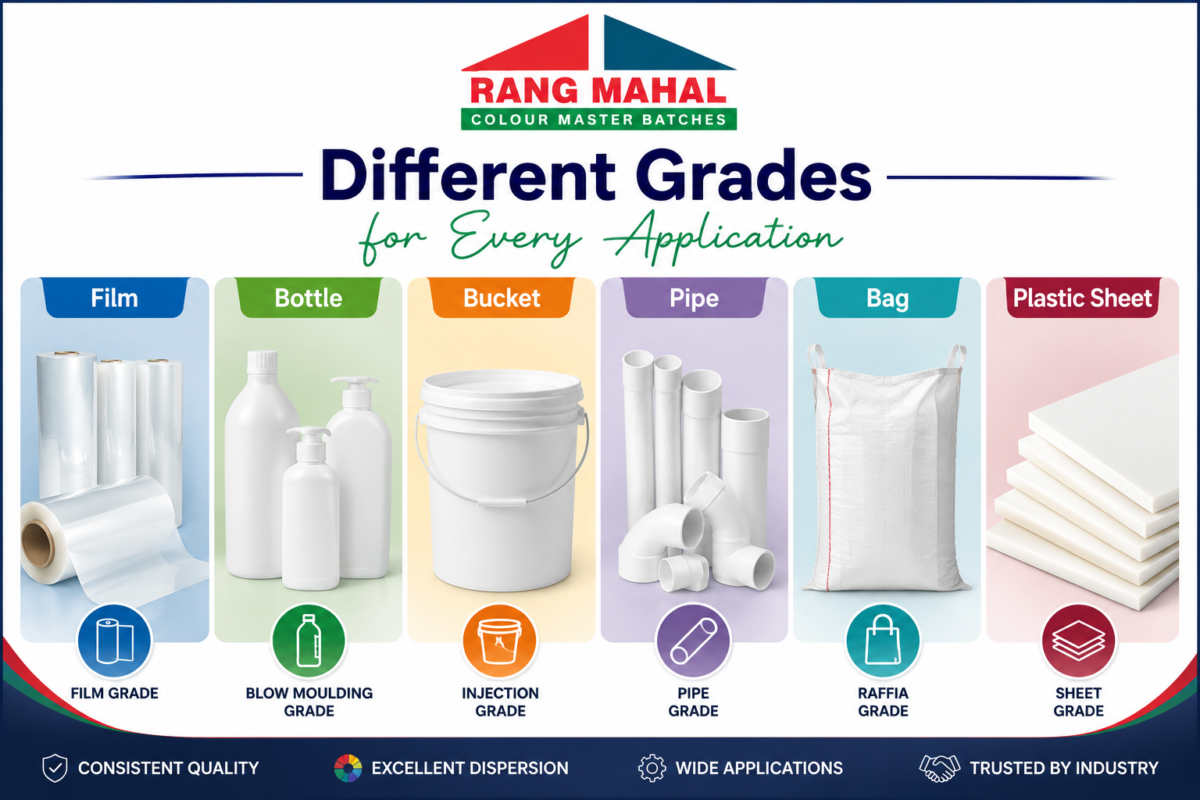
Different plastic manufacturing processes require different grades of White Masterbatch as well as Color Masterbatches to achieve the desired appearance and performance. Selecting the correct masterbatch helps improve productivity, ensure consistent color quality, and enhance the overall performance of plastic products.
| Grade | Common Applications |
| Film Grade | Packaging films, shopping bags |
| Injection Moulding Grade | Buckets, furniture, household items |
| Blow Moulding Grade | Bottles and containers |
| Raffia Grade | Woven sacks |
| Pipe Grade | PVC and HDPE pipes |
| Sheet Grade | Plastic sheets and thermoforming |
different-grades-of-white-masterbatch
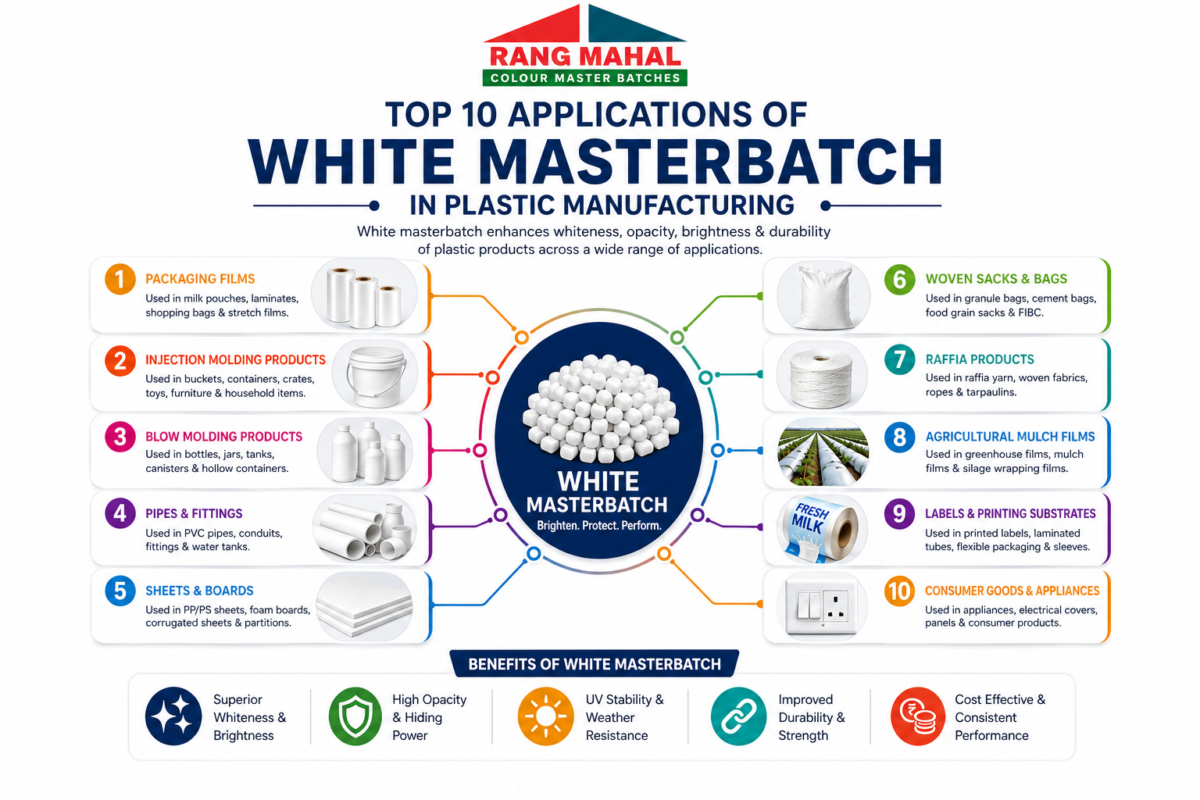
Top 10 Applications of White Masterbatch in Plastic Manufacturing
White Masterbatch is widely used across multiple industries because of its ability to provide excellent whiteness, opacity, and processing performance. Below are the top applications where it plays a vital role.
1. Packaging Films
Packaging is one of the largest applications of White Masterbatch. It helps manufacturers produce attractive and durable films used in food, retail, and industrial packaging.
Common products include:
- Food packaging films
- Shopping bags
- Carry bags
- Milk pouches
- Flexible packaging
Its high opacity improves product appearance while maintaining consistent color quality.
2. Blow Moulded Containers
White Masterbatch is widely used in blow moulding to manufacture strong and visually appealing plastic containers.
Typical products include:
- Shampoo bottles
- Detergent bottles
- Cosmetic containers
- Chemical containers
- Pharmaceutical bottles
Its excellent dispersion ensures a smooth and uniform finish across all products.
3. Household Plastic Products
White Masterbatch plays a significant role in manufacturing durable and visually appealing household plastic products. Consumers often associate bright white plastic with cleanliness and premium quality, making consistent color an important factor for manufacturers.
High-quality White Masterbatch ensures excellent opacity, smooth surface finish, and uniform color, even during large-scale production.
Common Household Products
- Plastic Buckets
- Mugs
- Storage Containers
- Laundry Baskets
- Chairs and Stools
- Kitchen Containers
- Dustbins
- Plastic Trays
Why White Masterbatch is Preferred
- Uniform white appearance
- Scratch-resistant finish
- Better surface gloss
- Excellent durability
- Consistent batch-to-batch color
Manufacturers using premium White Masterbatch from Rang Mahal can achieve reliable color consistency while improving production efficiency.
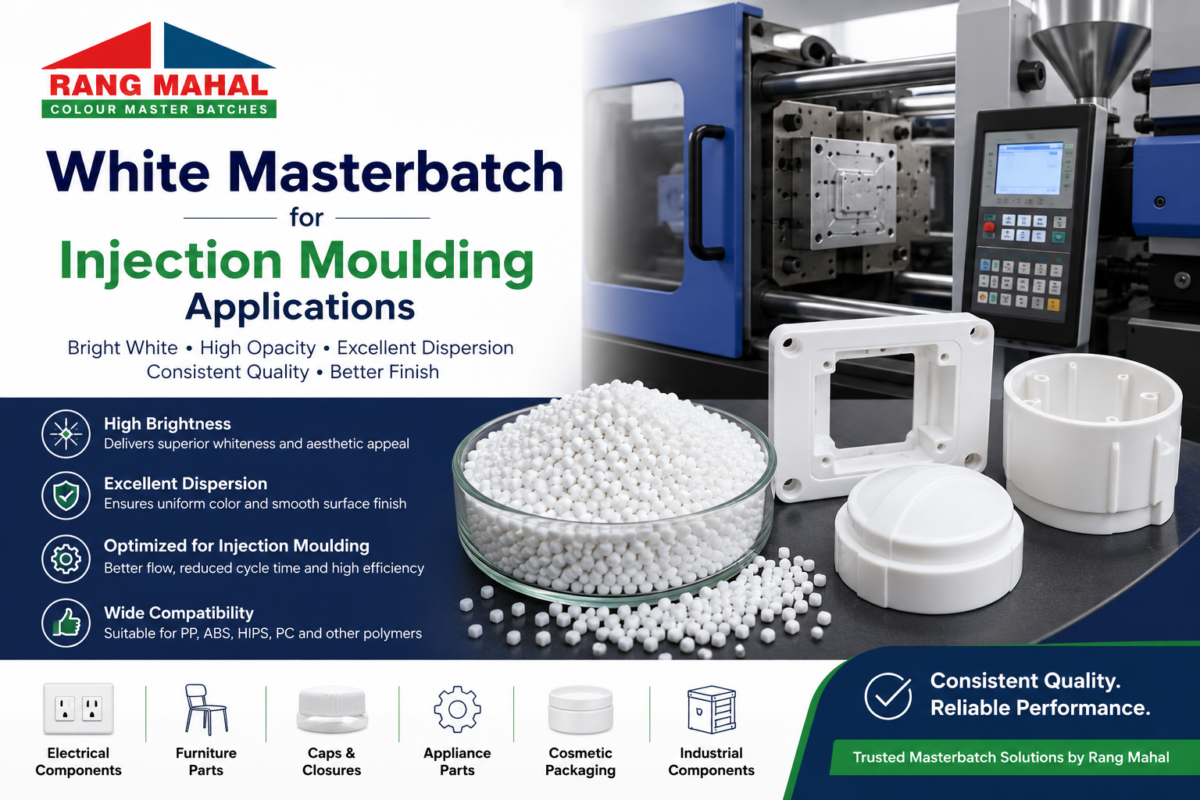
4. Injection Moulded Plastic Components
Injection moulding is one of the most common plastic manufacturing processes. White Masterbatch is widely used in this industry to produce components with high brightness, excellent finish, and consistent color.
Its superior dispersion helps reduce color variation, ensuring every moulded part maintains the same appearance.
Products Include
- Electrical Switch Covers
- Plastic Caps
- Furniture Components
- Appliance Parts
- Cosmetic Packaging
- Industrial Plastic Components
Benefits
- Better mould filling
- Excellent color dispersion
- Smooth finish
- Reduced production rejects
- Improved product aesthetics
white-masterbatch-for-injection-moulding-applications
5. Woven Sack Industry
The woven sack industry relies heavily on White Masterbatch to manufacture durable and attractive polypropylene bags.
It provides excellent opacity and color consistency while maintaining the mechanical strength of woven fabrics.
Common Applications
- Cement Bags
- Fertilizer Bags
- Rice Bags
- Flour Bags
- Industrial Packaging Bags
Advantages
- Better print visibility
- High whiteness
- Improved appearance
- Weather resistance
- Long-lasting color stability
6. Pipes and Fittings Industry
White Masterbatch is widely used in the manufacturing of PVC, CPVC, and HDPE pipes, where color consistency and durability are essential.
A premium formulation ensures uniform whiteness without affecting the mechanical properties of the final product.
Products
- PVC Pipes
- CPVC Pipes
- Water Supply Pipes
- Drainage Pipes
- Pipe Fittings
Why Manufacturers Choose White Masterbatch
- Excellent weather resistance
- Uniform color
- Better surface finish
- High processing stability
- Long service life
7. Agricultural Films
Agricultural films require high-quality White Masterbatch to provide UV stability, durability, and improved light reflection.
These films are widely used in modern farming applications.
Applications
- Greenhouse Films
- Mulch Films
- Silage Films
- Protective Crop Covers
Benefits
- Better UV protection
- Longer product life
- Improved crop performance
- Uniform appearance
- Excellent weather resistance
8. Medical and Healthcare Products
The healthcare industry demands high-quality plastic products with excellent hygiene standards and consistent appearance.
White Masterbatch is commonly used in manufacturing medical packaging and disposable plastic products.
Products Include
- Medical Containers
- Disposable Trays
- Syringe Packaging
- Laboratory Containers
- Pharmaceutical Packaging
Benefits
- Clean appearance
- Excellent opacity
- Uniform color
- Reliable processing
- High-quality finish
9. Automotive Plastic Components
Modern vehicles contain numerous plastic components that require consistent color and high durability. White Masterbatch helps manufacturers achieve premium aesthetics while maintaining performance.
Automotive Applications
- Interior Panels
- Dashboard Components
- Trim Parts
- Air Vent Covers
- Storage Compartments
Benefits
- UV stability
- Heat resistance
- Uniform appearance
- Excellent dispersion
- Long-lasting color
10. Electrical and Appliance Industry
White Masterbatch is extensively used in electrical products where appearance, insulation properties, and dimensional stability are important.
Common Products
- Switch Plates
- Plug Tops
- Socket Covers
- Appliance Housings
- Electrical Casings
Why It Is Used
- Attractive appearance
- Better surface finish
- Consistent color
- High-quality molding
- Excellent processing performance
Industries That Use White Masterbatch
| Industry | Common Products | Benefits |
| Packaging | Films, Carry Bags, Food Packaging | High Opacity & Brightness |
| Household | Buckets, Mugs, Containers | Premium Appearance |
| Injection Moulding | Plastic Components | Uniform Color |
| Blow Moulding | Bottles & Containers | Smooth Finish |
| Agriculture | Mulch Films | UV Stability |
| Pipes | PVC & HDPE Pipes | Weather Resistance |
| Automotive | Interior Parts | Heat & UV Resistance |
| Medical | Medical Packaging | Clean Appearance |
| Electrical | Switches & Casings | High Surface Finish |
How to Choose the Right White Masterbatch
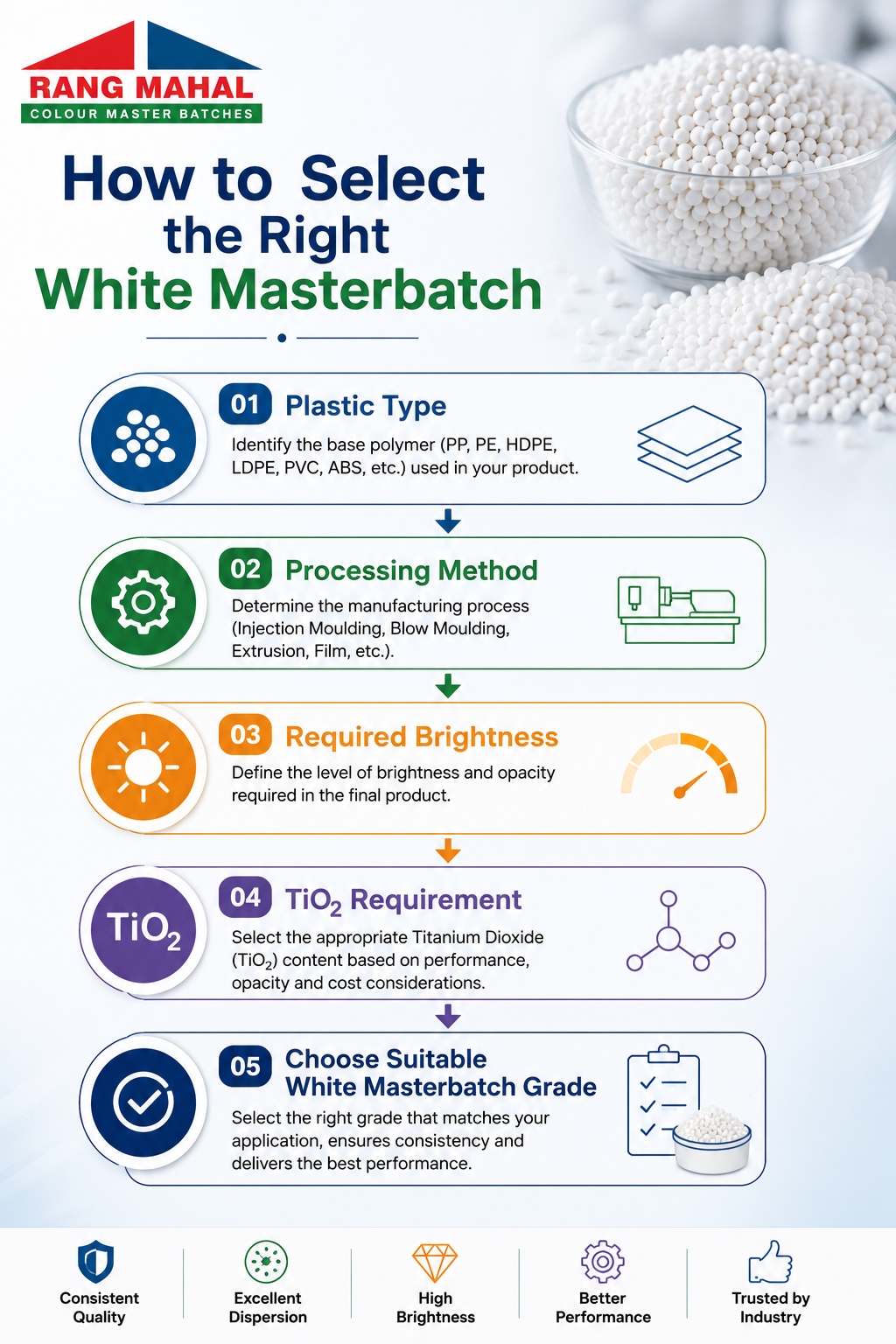
Selecting the right White Masterbatch depends on the application, processing method, and desired product performance. Considering the following factors can help manufacturers achieve better production efficiency and product quality.
1. Titanium Dioxide (TiO₂) Content
A higher TiO₂ percentage generally provides better brightness and opacity. However, the ideal concentration depends on the end-use application and cost requirements.
2. Compatibility with Base Polymer
Ensure the carrier resin in the White Masterbatch is compatible with the polymer being processed, such as PP, PE, HDPE, LDPE, PVC, or ABS.
3. Dispersion Quality
Uniform dispersion helps prevent streaks, shade variation, and surface defects, resulting in consistent product quality.
4. Processing Temperature
Choose a formulation that remains stable at the processing temperatures used in injection moulding, blow moulding, or extrusion.
5. End Application Requirements
Different industries have different performance requirements. For example, packaging films may prioritize opacity, while outdoor products may require enhanced UV resistance.
6. Manufacturer’s Technical Support
Partnering with an experienced manufacturer like Rang Mahal ensures access to technical guidance, customized formulations, and consistent product quality. If you are interested please contact us
Guide to Choosing the Right White Masterbatch for Plastic Manufacturing
Common Mistakes to Avoid When Choosing White Masterbatch
Selecting the right White Masterbatch is just as important as choosing the right polymer. Many manufacturers focus only on price, which can lead to inconsistent product quality, production issues, and higher rejection rates.
Here are some common mistakes to avoid:
1. Choosing Based Only on Price
Low-cost White Masterbatch may contain lower-quality raw materials or insufficient Titanium Dioxide (TiO₂), affecting opacity, brightness, and overall performance.
2. Ignoring Titanium Dioxide Content
TiO₂ is responsible for whiteness and hiding power. Selecting the appropriate TiO₂ concentration based on your application helps achieve the desired finish while optimizing costs.
3. Using an Incompatible Carrier Resin
A mismatch between the carrier resin and the base polymer can lead to poor dispersion, surface defects, and processing issues.
4. Overlooking Dispersion Quality
Poorly dispersed masterbatch can result in streaks, uneven color, and inconsistent product appearance.
5. Not Considering the End Application
Each application—whether packaging, injection moulding, pipes, or agricultural films—requires specific performance characteristics. Selecting the right grade ensures better results.
White Masterbatch vs White Pigment
Although both White Masterbatch and White Pigment are used to create white plastic products, they differ significantly in terms of processing, consistency, and overall performance.
| Feature | White Masterbatch | White Pigment |
| Ease of Processing | Excellent | Moderate |
| Color Consistency | High | May Vary |
| Dust-Free Handling | Yes | No |
| Dispersion | Uniform | Requires Proper Mixing |
| Production Efficiency | High | Lower |
| Waste Generation | Lower | Higher |
| Surface Finish | Better | Depends on Mixing |
For manufacturers aiming for consistent quality and efficient production, White Masterbatch is generally the preferred choice.
Which White Masterbatch Grade is Best for Different Plastic Applications?
Selecting the right grade helps improve product performance, reduce material waste, and achieve the desired finish.
| Application | Recommended Grade | Key Requirement |
| Packaging Films | Film Grade | High Opacity |
| Shopping Bags | Film Grade | Uniform Color |
| Blow Moulded Bottles | Blow Moulding Grade | Smooth Surface |
| Household Products | Injection Grade | Bright Finish |
| Plastic Furniture | Injection Grade | High Strength |
| Woven Sacks | Raffia Grade | Good Dispersion |
| PVC Pipes | Pipe Grade | Weather Resistance |
| Plastic Sheets | Sheet Grade | Uniform Appearance |
| Agricultural Films | Film Grade | UV Stability |
| Electrical Components | Injection Grade | Surface Finish |
Latest Trends in White Masterbatch
The plastic manufacturing industry continues to evolve, and White Masterbatch formulations are improving to meet changing market demands.
Some of the latest trends include:
- High-opacity formulations for premium packaging.
- Improved dispersion technology for smoother processing.
- UV-stabilized grades for outdoor applications.
- Customized formulations for industry-specific requirements.
- Solutions designed to support recyclable plastic products.
- Enhanced process efficiency with lower addition levels, depending on the application.
These advancements help manufacturers improve product quality while optimizing production efficiency.
Why Choose Rang Mahal for White Masterbatch?
Choosing the right manufacturing partner is essential for maintaining product quality and production efficiency.
Rang Mahal (Sachcolor) has built a reputation for delivering high-quality White Masterbatch solutions tailored to the needs of diverse plastic manufacturing industries.
Why Manufacturers Trust Rang Mahal
- High-quality raw materials
- Excellent opacity and brightness
- Uniform dispersion
- Consistent batch-to-batch quality
- Customized formulations for different applications
- Suitable for multiple processing methods
- Technical support for product selection
- Reliable supply across India
- Focus on quality and customer satisfaction
Whether your requirement is for packaging films, household products, woven sacks, pipes, injection moulding, or blow moulding, Rang Mahal offers White Masterbatch solutions designed to support consistent manufacturing performance.
Frequently Asked Questions (FAQs)
1. What is White Masterbatch used for?
White Masterbatch is used to provide whiteness, opacity, and consistent color in plastic products manufactured through injection moulding, blow moulding, extrusion, and film processing.
2. Which industries commonly use White Masterbatch?
It is widely used in packaging, household products, automotive, agriculture, medical, electrical, pipe manufacturing, and woven sack industries.
3. Why is Titanium Dioxide (TiO₂) important in White Masterbatch?
Titanium Dioxide is the primary ingredient responsible for brightness, opacity, and color consistency in White Masterbatch formulations.
4. Can White Masterbatch be used in food packaging?
Yes, food-contact suitability depends on the formulation and compliance with applicable regulations. Manufacturers should verify that the selected grade meets the required standards for their market and application.
5. Is White Masterbatch suitable for outdoor applications?
Yes. UV-stabilized grades are available for applications exposed to sunlight and varying weather conditions.
6. Which plastics are compatible with White Masterbatch?
White Masterbatch can be formulated for use with PP, PE, HDPE, LDPE, LLDPE, PVC, ABS, and several other polymers, depending on the carrier resin.
7. How do I choose the right White Masterbatch?
Consider factors such as the base polymer, processing method, TiO₂ content, dispersion quality, end-use application, and environmental exposure.
8. Why should I choose Rang Mahal White Masterbatch?
Rang Mahal offers high-quality formulations, consistent dispersion, customized solutions, reliable supply, and technical support for a wide range of plastic manufacturing applications.